Discover Developmental Benefits of Ropes, Swings, and More in Forest School

Discover Developmental Benefits of Ropes, Swings, and More in Forest School

The CPD workshop covers knots, hitches and techniques to build ladders, erect rope ladders, low ropes, nets, swings, hammocks and slack lines plus safety considerations and risk-benefit assessment. Discuss the developmental benefits of physicality and how to increase it within your Forest School, outdoor space, play area or outdoor learning sessions. #forestschool #appropriaterisk #woodlandskills #outdoorplay #physicality #play #learnerled #OT #occupationaltherapy

SATURDAY, 17 SEPTEMBER 2022 FROM 09:30-15:30

Ropes, Swings & Things-Physicality in Forest School

Shakespeare Junior School
Tickets are available here forms.gle/TyCUPPnGHT3fTQqF8

Unprecedented Changes in Forest School Programme: A Single Session Effect

Unprecedented Changes in Forest School Programme: A Single Session Effect

We have been working with this school for three sessions and during these sessions we have seen a number of changes and the teachers and adults present have often commented on their learning, behaviour, responsibility and general positivity during the sessions.
This particular week we saw the largest changes I have ever seen in ANY forest school programme and very much in a single session. The day had opened with this groups usual play and separated by activities with a  number very heavily involved with swing play, including trying to get the swing rope over the branch and number of the young boys were playing out their usual stick fights and developing discussion around safe stick use, den building, bases being built and running play.
as they settled and moved around the site, we noticed they were using different areas than previous weeks and that is not unusual as groups get used to their space.

As the session progressed I wanted to fulfil my idea for the session of trying to get some of the learners higher off the floor so installing a rope ladder was part of my plan. We have larger Beech trees along the edge of the site and most of the trees in the interior element are too small. I lashed a long rope between tree using branches and had the rope passing back and forth about four times over which I threw the ladder rope twice and then inserted the rungs with a marlin spike . I was abled assisted by two of the smaller learners from this group which have until now proved quite quiet and they assisted with some of the rung cutting and inserting the rungs.

What happened over the next ninety minutes or so was quite something! A few of the learners asked what it was, others could see it was a rope ladder. Some of the more ‘confident’ learners (I say that as they are ones who I knew their names and were very upfront and centre in the group) really struggled to get their body in the right stance to climb without the rope wildly swinging and them struggling to stay on. Then a young person climbed it with total ease and needed no input from an adult, second or third time they climbed passed through the gap at the top and descended the other side, totally unexpected (again, I say this as they have been very quiet during the sessions and on the periphery of the play).

That same learner and one of those who helped with the rung cutting started to find long straight sticks and climb them like someone getting a coconut from a tree, shimmying up the wood to get to the lower branches of the Beech trees. Others could not quite get the right body position and were too upright. This one child continued to lead the way. Now the extraordinary thing is that the teachers had ever seen this side or would ever have expected it from this child. This child suddenly went from in the background to the ringleader and explaining that others had to do to achieve.it was fascinating to watch others in the group take the idea and attempt to get into the lower branches of the trees, some succeeding and others not quite but the physical demands of the techniques they were attempting was a real challenge for some. Form the adults there was  ‘wow look at that’ look a X  they’d never do that anywhere else’  ‘I didn’t expect that from y’ and it want on for the remainder of the session.

Forest school level three training

Forest school level three training

This training course is essential for anyone wishing to lead Forest School programmes in their own setting. It covers learning theory and practical skills. Plus it gives participants the confidence and knowledge needed to establish and deliver their own Forest School programmes. If you want to know more about Forest School here is a great short video produced by the Forest School Association. “What is Forest School?”

Our Forest School Leader Training is run by experienced leader and trainer, Adrian Goodhand, and accredited by the awarding body QNUK. The course covers a combination of practical skills (tool use, fire lighting, campfire cooking, knot tying, identifying and using natural materials etc.). Theoretical skills (holistic development, self esteem theory, learning theory, learning through play etc.). The course also covers how to set up a Forest School programme, risk management and sustainable use of woodlands and resources. A detailed qualification specification can be found here.

Forest School Leader (Level 3) training course is run over a number of months. This is to help participants take on board the course learning, spread the coursework assignment load and reflect on their training. Level 3 trainees receive 9 or 10 days of training. This is split into 4 modules. In addition to the training days, participants will be required to set up their own 6 week pilot Forest School programme. In addition submit a coursework portfolio within 12 months of starting the training. The course is described as 24 days worth of work – 9 to 10 days attending the training days and the rest is self directed learning time.

We have two courses starting this coming November one in Surrey at the wonderful Nower Wood Nature Reserve, Surrey Wildlife Trust details can be found here.

The second is at the Sustainability Centre, Hampshire details are here

School Grounds and Woods: Impact on Children’s Play Development

School Grounds and Woods: Impact on Children’s Play Development

I have worked with some of these learners for a number of months now and for a while we were working on their school grounds as the return to school settled.

After Easter we returned to the woods and their development and style of play has changed, obviously as we have a much richer environment. Additionally, their return to tools, they had a term off for swimming, has shown a significant development as a fair number of them are now able to use the saws and other tools without any support, or interference, from an adult or myself and this has allowed further development which included the cutting of discs for a game.

This arose as one child who attends has issues with transition so a game of connect four was brought to aid them. From this we started cutting discs to make a woodland version and then onto a game of noughts and crosses.


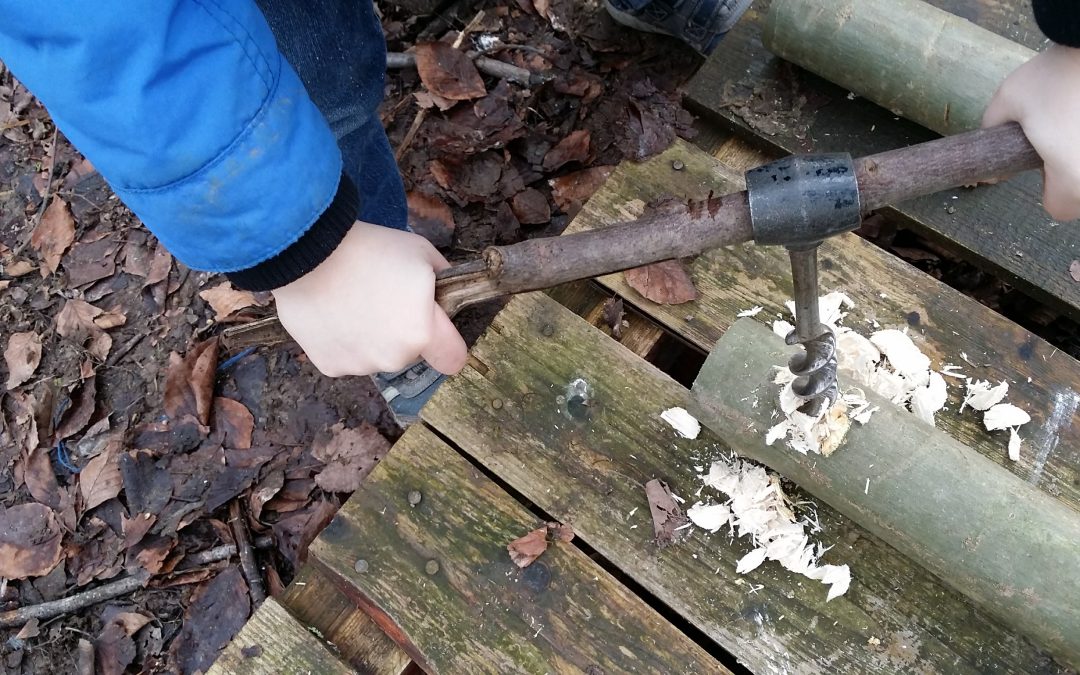
another child using a bow saw

QNUK L3 RQF Award Forest School & Paediatric First Aid

QNUK L3 RQF Award Forest School & Paediatric First Aid

Friends of Elfwoods Dangstein, Dangstein Road, Petersfield GU31 5BZ
booking form and further information can be found here forms.gle/VXzjvSk3RX6JPG77A

Join us for this QNUK Level 3 Award in Forest School First Aid (RQF) course is suitable for those working within Forest School or outdoor education.

Suitable for Forest School practitioners who may need to undertake up to 3 First Aid and emergency outdoor response qualifications to meet requirements. This qualification ensures they can meet those same requirements simply by completing one qualification. Available to those over 16 years.

Candidates should be at least a level 2 numeracy and literacy or equivalent. Some pre-course work may be required.

This qualification will also include Paediatric First Aid suitable for working with under 18 year olds.

Certificates also available EFAW and Outdoor First Aid with additional costs per certificate.

PRACTICAL VENUE

Dangstein, Dangstein Road, Petersfield GU31 5BZ

DATE / TIMES

11th and 12th June 9am to 6pm both days and attendance is required for all hours.

You will need to provide at least 1 form of photo I.D. If photo I.D is not available, 2 forms of nonphotographic I.D can be produced.

Cost £165

Contact courses@coastandforest.co.uk for more information or book here https://forms.gle/VXzjvSk3RX6JPG77A